Keightley the key to unlock England’s talent & catch up with Australia

Following her appointment in October, Ollie Godden looks at the reasons why Lisa Keightley could help England’s female cricketers catch up with Australia.
If you can’t beat them, hire them.
It’s becoming something of a trend for English teams to employ Australian coaches in order to turn around a lean patch.
Eddie Jones was one; Trevor Bayliss another. Now it’s the turn of Lisa Keightley as she was last week appointed the new England women’s cricket head coach.
The 48-year-old was already set to take the reigns of an English team next summer, having been announced as the women’s coach of London Spirit in The Hundred.
But she will now relinquish that role in favour of taking charge the national team after Mark Robinson – who led England to their sublime World Cup victory on home soil back in 2017 – resigned.
A fine player – averaging nearly 40 in ODIs and becoming the first woman to score a century at Lord’s in 1998 – Keightley has since coached Perth Scorchers in the Women’s Big Bash League (WBBL) amongst other domestic roles.
She was also the Australian women’s head coach between 2007-2008, the first female to hold the position. Coincidentally she will now also become the first full-time female head coach of England’s women.
It is not just her exploits on the pitch and as a coach which made her the stand out candidate for the role, but her knowledge and experience of the Australian system in general; of how it works and how to overcome it.
The ECB have confirmed that former Australia international Lisa Keightley is to become to the new England Women’s Head Coach.
The current @ScorchersBBL WBBL coach will take up the role formally in January and is the first full-time female Head Coach of @englandcricket. pic.twitter.com/GT947bY39Q
— Test Match Special (@bbctms) October 30, 2019
Australia’s dominance has been plain to see for a long time. The side has not lost a One Day International since October 2017 and hammered England 12-4 in the multi-format 2019 Ashes.
It’s safe to say that investment has had a large role to play in Australia’s stay at the top of the rankings. After failing to reach the 2017 World Cup final, Cricket Australia agreed a deal which saw payments lifted from $7.5 million to $55.2 million and a minimum retainer for international representation set at $72,076.
However, it is not the representation fee that has automatically created a winning streak, but the general professionalism in the game that the investment has bought, as most clearly shown in the running of the WBBL.
It has allowed talented players to become athletes dedicated to their craft and provided opportunities for players with promise. This includes 16-year-old-Pheobe Litchfield, who is already creating headlines in her debut WBBL season, becoming the youngest player to notch a 50 in the competition.
This would not be possible with a coaching structure in place to facilitate the development of individuals. Speaking to the Sydney Morning Herald, Australia coach Matthew Mott explained how the country’s investment in coaches over a period time has been a major factor behind the women’s international success.
In short, Australia have created a blueprint for success. Increased Investment, brilliant players and quality coaching equals success and Keightley has been at the heart of that.
The ECB have already taken steps to emulate that, with the aforementioned The Hundred at the heart of their plans.
Whilst there has been controversy surrounding the format, there is no doubting that it will supersede the Kia Super League in terms of strength and Keightley believes that stronger domestic competitions will create better domestic cricketers which will, in turn, mean greater international sides.
She represented Australia in 92 internationals, scoring 3,009 runs including a career-best 156* in an ODI against Pakistan in 1997.
She was the first female cricketer to score a century at Lord’s.
Happy Birthday, Lisa Keightley! pic.twitter.com/duT832jWDq
— ICC (@ICC) August 26, 2019
The eight regional performance centres born out of The Hundred will also provide an important pathway for domestic players not yet on the international stage. Every year, five players from each region will gain full-time deals independent of the central contracts, meaning there will be 60 full time female cricketers within a year and over 100 in five years time – a catalysed for an improvement in standards.
The ECB announced last month that £20million will be invested over two years, and £50million over five, to help fund 40 full-time professional contracts and help grow all areas of the women’s game. There’s one tick.
And now, by appointing Keightley, the ECB have someone at the helm who not only knows how to implement this level of funding in the best way possible, but someone who understands how to do it in English cricket.
That’s because the former New South Wales batter was also in charge of the England Academy between 2011-2015 and will have worked with many of the current crop of internationals.
She understands what is needed to succeed yet respects how this can be converted into a familiar structure elsewhere.
As head coach of the Scorchers, Keightley will seen more of the likes of Ellyse Perry, Meg Lanning, Alyssa Healy et al. than most others and will consequently have more plans of how to overcome and beat them, something which seemingly no-one has done for quite a while.
And with a host of world class stars already at her disposal – Tammy Beaumont, Danni Wyatt, Heather Knight and Nat Sciver to name a few – she certainly has the talent there to close the gap before the investment brings through a new and expanded group of international stars.
With the T20 World Cup just a few months away, there will be an early opportunity for Keightley to show her credentials as England seek to exact revenge on Australia after losing in the 2018 final.
Q&A: Get to know Lisa Keightley – The new Head Coach of England Women on her new role, the Ashes, the 2020 ICC Women’s T20 World Cup and more…
➡️ https://t.co/x6Y44Vuutf pic.twitter.com/KX7eBgPi6g
— England Cricket (@englandcricket) October 30, 2019
She certainly faces a tall order though to turn around the fortunes of a side that performed rather poorly this summer so quickly.
In truth, the test of whether this theoretically shrewd move will manifest into on field success will be judged over a long period of time.
here is an opportunity for Keightley to assemble the components of a successful side at a time when the ECB are making a real and tangible pledge to driving forward the standard of the women’s game.
Undoubtedly an exciting voyage lies ahead, and Lisa Keightley is could be the driver of change.
The remarkable rise of GB women’s basketball
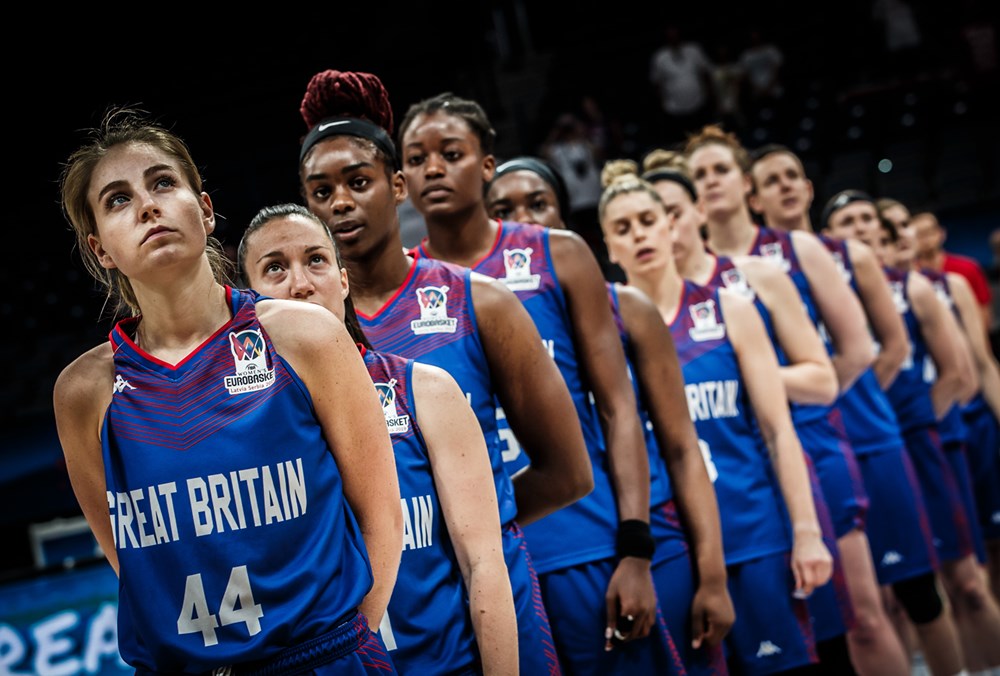
Great Britain’s women’s basketball team are ‘on the cusp of something special’.
These are the words of Basketball England CEO Stewart Kellett. And he’s not wrong.
In 2017, they failed to reach for the main draw at the Women’s EuroBasket event. In 2018, they were threatened with disbandment after Sport England withdrew emergency funding.
Yet now they find themselves in with a chance of appearing at Tokyo 2020, having finished a historic fourth at this year’s EuroBasket event and securing a place at the 2020 FIBA Olympic Qualifying Tournament in February.
Furthermore, England’s women also secured a superb silver at last spring’s Commonwealth Games.
This remarkable turnaround has been overseen by the enigmatic head coach Chema Buceta, who was first appointed in 2015.
But for the Spaniard even reaching Tokyo – the first time a British women’s team would have qualified for an Olympics after appearing as hosts in 2012 – would only be half a job done.
He knows his team still have the capability to improve even further.
“When you have a good group of players with a good attitude who believe they can do it and you give them the chance to grow, to take responsibility, to be ambitious about achieving something then anything is possible,” he said.
“What is important is that we are able to compete at a high level and get the results. If we want to continue at this level we have to move forward, keep doing things well and improve the things we have to improve.”
GB’s @EuroBasketWomen campaign comes to an end after seven games in eleven days.
During that time we’ve secured our highest-ever #EuroBasketWomen finish and our place in the Olympic Qualifying Tournament.
An incredible journey and an incredible team 🇬🇧❤️ pic.twitter.com/dTTwr1MMPV
— GB Basketball (@gbbasketball) July 7, 2019
When put into context, what this have achieved over the past two years really is astonishing.
UK Sport cut their elite funding in 2016, while Sport England withdrew a £10m grant two years later despite basketball being the second most participated activity in the UK, with 1.2 million participants.
This left the international teams on the brink of not being able to play until 2020 at the earliest, yet less than two months later they overcame Canada – ranked fifth in the world – on their way to that silver at Gold Coast 2018.
They then gave eventual champions Spain and London 2012 runners-up France serious scares at the recent EuroBasket event, proving they can mix it with the world’s best on their day.
It may be a very British trait to relish in the role of the underdog but for Kellett he believes this has helped bring the best out of the players.
However he also hopes their recent successes can also lead to the authorities boosting their cashflow so the players can fully realise their potential.
“At the EuroBasket tournament everyone underestimated us but we kept winning and each time the team managed to punch above the weight of the money we’ve got,” he reflected.
“The belief in the women’s game has really rocketed. There’s a real pride that has developed around the team and a belief that we’re on the cusp on something special.
“We’ve done so well with so little resource that the feeling is that if we just got a little bit more support, just think what we could do.
“We’ve been the underdog and won. We’ve been the underdog with no money and won. Now we’re in the Olympic qualifier and there’s an expectation that’s rising and we do need to put resource on it to get over the line.”
What a ride!Thank you to everyone that followed our journey! To my TEAM…the toughness, grit and passion we play with is why I love this squad.We gave it everythìng we had and now we have the chance to qualify for TOKYO! Enjoy your rest and get ready to hunt in Nov and Feb! pic.twitter.com/T3eocBIO6F
— Rachael Vanderwal OLY (@rachvanderwal) July 9, 2019
There can be no doubting that there is some serious talent in this team. Temi Fagbenle – who plays professionally for Minnesota Lynx in the WNBA – averaged a tournament-high 20.9 points per game at this year’s EuroBasket. Johannah Leedham averaged more steals (3.4) than anyone else as well as providing 4.7 assists per game.
The team is also full of experience, with five players – Leedham, Fagbenle, Stef Collins, Rachael Vanderwal and Chantelle Handy – having played at London 2012.
Sacrifice and a desire to play for their country have also been key characteristics behind their remarkable resurgence. However Buceta believes it is another that has played the most crucial role in their rise.
The willingness to change.
“Elite athletes in any sport, if they are successful they don’t like to change,” he explained.
“After one of my first campaigns here – where we didn’t quality for the main EuroBasket event – we had a meeting and said if we do the same the result will be the same. We have to change.
“These women, even those who were 30+, were able to change and this has been very important. It’s not always easy for a 30-year-old to change things they have done for many years.
“But the attitude to change, to take more risks, to do things they haven’t done before, to go out from their comfort zone, that is a great quality of this team.”
Can they qualify for Tokyo 2020? If you combine recent form, the skill and desire of the team and the fact that there are 10 spaces to be filled at the upcoming qualification tournament, they certainly have a strong chance.
Women’s team sport is flourishing in this country right now and this could be the time for basketball to join the party as a major player.
THIS. TEAM. RIGHT. HERE 👏👏 pic.twitter.com/DXDid8nEAM
— GB Basketball (@gbbasketball) July 4, 2019
We will return with a second basketball piece next week, outlining the brand new All Girls campaign and how Basketball England will be using it to attract even more participants to the sport and use the success of the national teams to inspire the nexts generation. #BeSeenBeHeardBeInspired
Beevers continuing to set records as women’s rugby league flourishes
How did you celebrate your 18th birthday?
Studying for your A-levels? Buying your first round? Taking in a nightclub?
How about helping your club to a historic domestic double in a game shown live to thousands of people on Sky Sports?
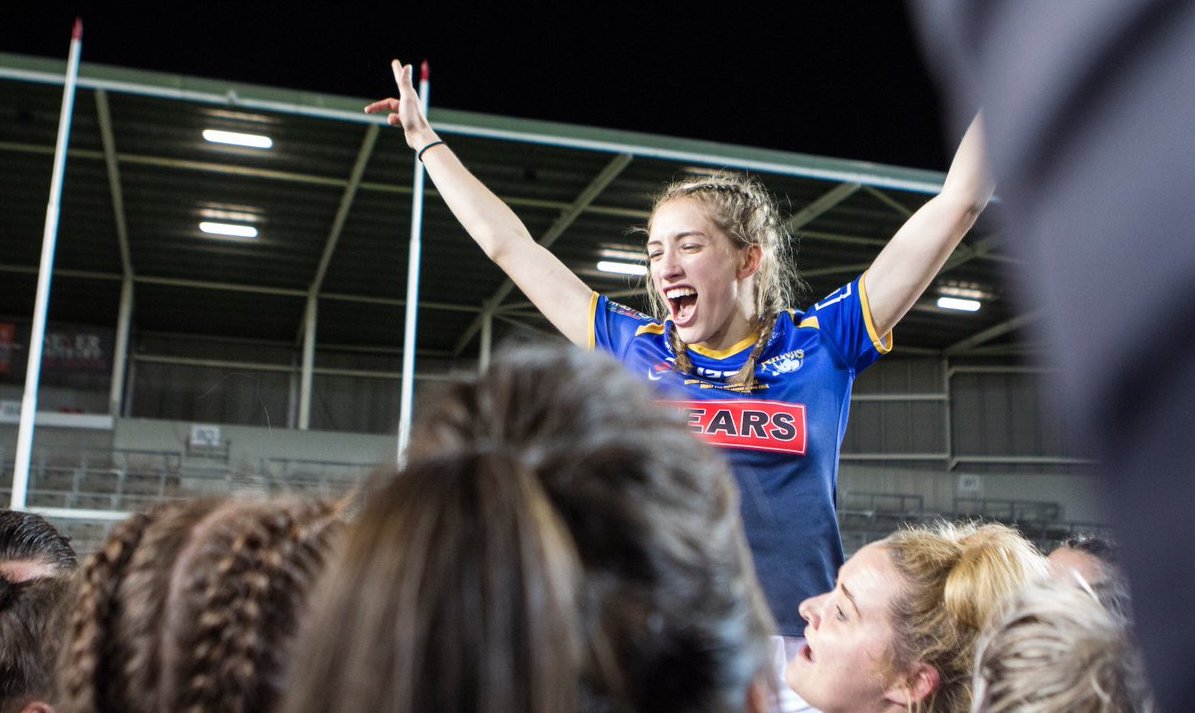
That’s exactly what Caitlin Beevers did on Friday, playing a pivotal role in helping Leeds Rhinos secure victory over Castleford Tigers in the Grand Final to secure their first ever Women’s Super League title.
It’s the culmination of an incredible 22 months on the pitch for the fullback that started with her selection for the Rhinos U19 academy in January 2018, saw her promoted to the senior team just weeks later, finish as top try scorer last season, win two Challenge Cups alongside the league title and score two tries on her England debut last October.
Beevers has now flown out to Australia having been selected to represent her country once again in the inaugural Rugby League World 9s, has also been picked for a historic tour of Papua New Guinea and is widely regarded as one of the finest young players in the world game.
It has been a truly remarkable ascent, one that even the Dewsbury-born player never saw coming.
Speaking about it in an interview with SportSpiel, she recalled: “I’d trained a few times with Leeds U19s and then we trained with the first team and that was the first time I met my the players who would become my team-mates.
“It was amazing to firstly get into the first team as it wasn’t something I expected so early on, with me not playing any games for the U19s.
“And then I never imagined the first England call. Don’t get me wrong, it was a huge goal of mine but I just thought it was miles ahead into the future, not at this age.
“I was massively shocked [to be selected for the World Cup and Papua New Guinea]. I didn’t expect to get the call for either.
“It’s something really, really special and it’s an absolute honour to represent my country again.”
Yesterday was my 18th birthday and I spent it with the best people @leedsrhinos ! And we went on to win the Grand Final which gives us the double!! And finally, going Oz for the 9s World Cup with the England girls today! Thank you to my family, friends, coaches and supporters!🦏 pic.twitter.com/kXpg3OF7e4
— Caitlin Beevers (@CaitlinBeevers1) October 12, 2019
Even though she has only just turned an age where she can legally vote, Beevers has already become a star of the game in this country.
And unlike those who have gone before her, the former St John Fisher pupil is able to show her outrageous skill and pace to the watching world as women’s rugby league continues to attract ever more supporters and media coverage.
As well as the Grand Final being shown on Sky, both of Leeds’ Challenge Cup victories have been streamed on the BBC.
More than 4,000 people also turned up to watch this year’s cup final at the University of Bolton Stadium, while clubs have also been taking some of their games to men’s stadiums this year, something we have subsequently seen in the FA WSL.
Having grown up only with male role models to try and emulate, Beevers is relishing the opportunity she has to inspire the next generation of rugby league stars.
“When I was younger the only people I could look up to were the males playing in the Super League,” she said.
“But now young girls have women to look up to and aspire to be and I think that’s absolutely fantastic for the game. It shows how much it is growing. There’s so much great talent coming through the system at every level and at every club.
“This year’s Challenge Cup final was an outstanding game and it really promoted the women’s game in a phenomenal light.
“A lot of people watching may not have even seen it before so what an introduction that would have been to them.
“And to get 4,000 people coming to the game, some of those may have bought their daughters to watch so hopefully they have been inspired to try and get to our level one day.”
😲 Who could forget this scorcher from @CaitlinBeevers1 in the Challenge Cup semi-finals?
👊 @Saints1890 and @LeedsRhinos meet again in the @Betfred Women’s Super League semi-finals, LIVE on #OURLEAGUE from 1pm.
Sign-up to watch 👉 https://t.co/1wOSE7FFjx pic.twitter.com/PhiXV6zsjP
— Rugby Football League (@TheRFL) October 6, 2019
It’s not just as a player where Beevers is breaking boundaries either.
As we wrote last year, she first shot to prominence by becoming the first woman to referee a game at Wembley Stadium, taking charge of the 2018 Year 7 Boys’ National Schools Final on the same day as the men’s Challenge Cup final.
She has since gone on to officiate a number of other high profile games, including a first international game as a touch judge when an England Youth side took on France.
Beevers is following in the footsteps of Belinda Sharpe, the first woman to referee an NRL match having taken charge of Brisbane Broncos v Canterbury-Bankstown Bulldogs earlier this year after also being the first to run the line in the men’s league back in 2014.
And as well as inspiring women to take up the game she loves, Beevers also wants to give them the self-belief to be able to pick up a whistle too.
“I couldn’t find words to describe it at first,” she said of her historic Wembley day.
“It was such a big record to hold and such a big event on the calendar to do it at as well, at Wembley on Challenge Cup day.
“At the end of the game someone told me to look around, take a minute and I had no words for the occasion. It was something special.
“I’m there to do my job and if people can look at me and be inspired then I’m happy; it’s a win-win.
“If promoting female officials can come through me I would put my hand up for that. If they questions I’ll be there to answer them because at the end of the day that will help them grow in confidence.”
Do you have what it takes to be a Rugby League Match Official? There are more opportunities than ever before! We have upcoming courses in:
📍 Warrington (18th August)
📍 Halifax (1st September)
📍 Mansfield (3rd November)👉https://t.co/o6kyX3tkCY#GiveitaTRY pic.twitter.com/LrvrzGCFZ3
— RFL Referees (@RFLReferees) July 31, 2019
Why The Hundred should be a force for good for English women’s cricket

After a disappointing 2019 and the conclusion of the Kia Super League (KSL), Ollie Godden explains how he thinks The Hundred could revolutionise English women’s cricket.
The Kia Super League was the jump start English women’s cricket needed.
Having played a significant part in continuing to grow the game in this country, the tournament was largely seen a success. It acted as a pathway for national representation and allowed domestic players to rub shoulders with the best in the world.
However, the birth of The Hundred will offer opportunities to advance the women’s game in England beyond what the KSL could have ever achieved.
As the curtain came down on the KSL’s existence, many mourned the death of a platform which helped take women’s cricket in England to new heights. A factor behind the thrilling 2017 World Cup win, it should be recognised for the job that it has done in growing cricket.
But it was never destined to last. A standalone tournament with little or no integration with the men, it stalled while other tournaments – notably the Women’s Big Bash League – continued to grow.
And while The Hundred may be a unique venture into the unknown, the ECB are planning on running the men’s and women’s events side-by-side. Furthermore, it is also included it as a key part of their exciting new #InspiringGenerations project, with £20m set to be invested in the women’s game over the next four years to elicit gender equality across the sport.
🚨 BREAKING NEWS 🚨
Our England stars’ destinations for #TheHundred!https://t.co/agZUDu6tjp pic.twitter.com/a3IdHDQQ27— England Cricket (@englandcricket) October 3, 2019
Players will be split across the franchises through a two-stage draft, the first of which has already been completed with 16 of England’s centrally contracted stars snapped up. The second round will see teams permitted to choose one more of the remaining England internationals and up to three overseas players, leaving the nine remaining spots to be filled with domestic talent which was seen aplenty in the KSL.
The eight franchise competition will kick off next summer, and, amongst the mayhem and confusion that has been born out of the media swirl – including rules which are still seemingly being manipulated – an objective truth has been realised by a minority: The Hundred has potential to be a force for good for the players, coaches and fans.
Most notably, the teams will be strong. Very strong. Do we need a new format to facilitate strong teams? Probably not. Does the advent of a new format make the selection process more intriguing? Absolutely.
The women’s game has never been filled with so much ability globally and this selection process will ensure star-studded line ups, leading up to an abundance of cricketing strength across the regions.
Delighted to be playing for Southern Brave in the first year of TheHundred 💯 💥 pic.twitter.com/QYp26KdZbq
— Danielle Wyatt (@Danni_Wyatt) October 3, 2019
Facilitating coach development is another potential positive of The Hundred. It is hoped that it will act a breeding ground for coaching prospects and a tester for established ones, the new format providing an opportunity for them to prove their worth in unknown experiment.
Of the seven franchises to announce their women’s head coaches, five have selected women, with four of those – Salliann Briggs (Trent Rockets), Charlotte Edwards (Southern Brave), Danni Hazell (Northern Superchargers) and Lydia Greenway (Oval Invincibles) – being English. And while the men’s tournament is being heavily criticised for a lack of home representation, The Hundred could play a significant factor in not just producing the next generation of talent but also potential future England women’s (or men’s) head coaches.
Furthermore, the simultaneous running of the men’s and the women’s events provides both sides with resources to feed off from one another, as has been the case with the Big Bash. As Briggs aptly described: “once everything is aligned, you are part of a wider strategy, and with that you get better investment, better resourcing and better people”. This shared strategy refers to the festival atmosphere at grounds which will serve to attract new fans into the spectacle and both events will benefit from the experiences of the other, even if it is true that the women’s game has more to gain in terms of popularity and growth potential.
Excited to finally be sharing our plan to transform women’s & girls’ cricket. It’s been a long time in the making. I have been so heartened by the level of support from everyone involved in the game. Look out for the announcement at 1pm. #InspiringGenerations pic.twitter.com/JIlE1hc8TB
— Clare Connor (@ConnorCricket) October 8, 2019
The Hundred represents what is hoped will be a seminal turning point for women’s cricket on home terrain both at the elite end and the grassroots level after a difficult year. England were outplayed and outclassed in the 2019 Ashes and it’s hard to disagree that England’s amateur domestic structure, both in terms of the wage and provision, is a “big contributing factor” to this drastic loss, as claimed by Clare Connor, the Director of England Women’s Cricket.
It’s not perfect yet – the discrepancy in the salaries between the men and women is a serious concern – but it could be the change that was needed.
Having now announced their #InspiringGenerations project, the focus has switched to not just improving the elite women’s game but the sport at all levels. The standard of cricket needs to improve in order to keep up and overhaul Australia once again and it is hoped increasing the professionalism and investing more in the grassroots will achieve just this.
It was a privilege to help launch the @ECB_Cricket action plan to transform women’s and girls’ cricket today. Really exciting times ahead. #InspiringGenerations pic.twitter.com/g0wmPXgX3S
— Heather Knight (@Heatherknight55) October 8, 2019
Clearly only time will tell whether the potential growth for cricket will be realised through The Hundred. The correct steps have, however, already been taken in utilising the competition as an avenue for raising the standards of the game from a playing and coaching perspective.
From the fans’ perspective, we have seen a recent shift in the perception and popularity of women’s football, and have experienced just how strategic implementation can grow the game. The Hundred can be the avenue through which new fans are attracted to cricket. An accessible route into the sport for the novice, and an intriguing spectacle for the veteran, the engine of women’s cricket is running and The Hundred may well shift English cricket through the gears and into a new top speed.
McCallin ready to use Euros pain to ensure GB qualify for Tokyo 2020
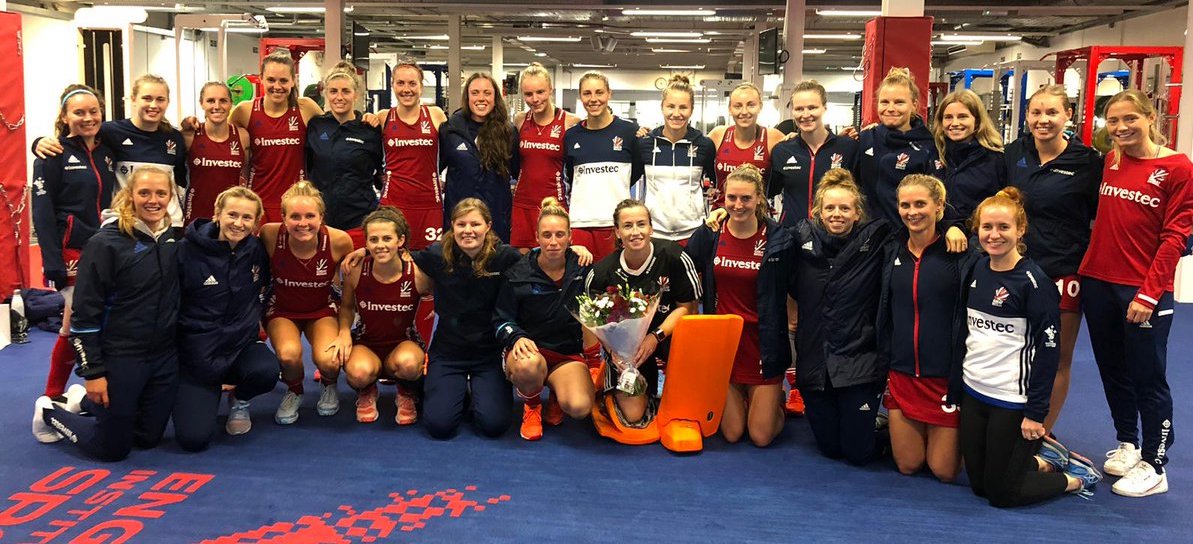
Rio 2016 hockey gold medallist Shona McCallin explains how she and her England team-mates will be using their Euros disappointment to ensure GB qualify for Tokyo 2020.
I’m back! Back on the international hockey scene after 17 months out of the game and back blogging for The 52.
When asked to write a piece on England’s recent EuroHockey Championships campaign, I was slightly reluctant at first.
On paper, it was our worst European showing in more than a decade. You have to go back to 2003 as being the last time England’s women finished outside the medals at the event; until now.
I’m personally still very much hurting from the tournament. To finish fourth, outside of the medals, hurts; the way we performed hurts and the semi-final result really hurts.
The scars from our 8-0 defeat at the hands of the Dutch run really deep and will be etched in my memory for a long time. I’ve not watched the game back but I will. I will because it will help the recovery process. I will because I don’t shy away from uncomfortable things. I will because I want to learn.
I will because I want to ensure it never, ever happens again.
Going into the tournament, a victory for England would have ensured a place at next year’s Olympics for Great Britain’s women. That was our aim. It didn’t happen so the focus now switches to regrouping as a GB squad and qualifying through a two-legged Olympic Qualifier.
The draw for the event took place last month, with Chile selected as our opponents, a team I’ve never played against in my six years as an international hockey player. We will face off in two matches over two days in London on 2-3 November, with the aggregate score totalled up and the winner taking it all – Olympic qualification.
CONFIRMED: Our opponents for the @FIH_Hockey Olympic Qualifiers have been chosen 🙌
Men: 🇲🇾 (Malaysia)
Women: 🇨🇱 (Chile)Both sides will contest a two-legged tie against those teams at @LeeValleyHTC on 2 & 3 November 🏑 pic.twitter.com/wIdOOnWk19
— Great Britain Hockey (@GBHockey) September 9, 2019
There is no opportunity for an off day, no opportunity to qualify through a different route.
This is it, crunch time.
We win the series, we qualify. We lose, we don’t qualify. Simple.
As Tokyo draws closer, I’m finding myself having more frequent conversations with friends and family members about the Olympics.
The conversations are often long and quite confusing, leading me to think that the whole qualifying process is unnecessarily complicated for both hockey and non-hockey fans.
It requires some teams to wrack up a serious amount of air miles and is not consistent across continents. For a team like Spain to qualify, they had to win the Euros, overcoming six of the world’s top ten teams. Conversely, New Zealand secured their place by winning a three-game series against Australia. I hope it’s a process that’s amended by our governing body, the FIH, before Paris 2024.
19.08.2016
3 years ago yesterday 🥇
#timeflies pic.twitter.com/zyTpbwwK5h— Shona McCallin MBE (@SMcCallin) August 20, 2019
I always state that, first and foremost, GB women still need to qualify – winning gold at Rio 2016 doesn’t automatically qualify you for Tokyo 2020.
The countdown is on and training has begun. A gruelling first week of fitness testing is out the way and it’s now about knuckling down as a team to ensure we are in the best shape, physically and mentally, come that first game on 2 November.
Some good and honest conversations between the whole squad and staff have been had and actions put in place. A clear and structured training plan has been implemented to improve the areas of our game that fell short as both GB during the FIH Pro League and as England at the Euros, whilst we will also continue to build on our strengths.
This Olympic qualification process means we are all entering an unknown that is exciting, nerve-wracking and pressurised.
Never has a place on the pinnacle of our sport rested on two matches in 24 hours and it’s time to show up.
Come the first weekend of November, we will be ready. And we hope so see many of you there cheering us on!
The track and field stars hitting back against body shamers
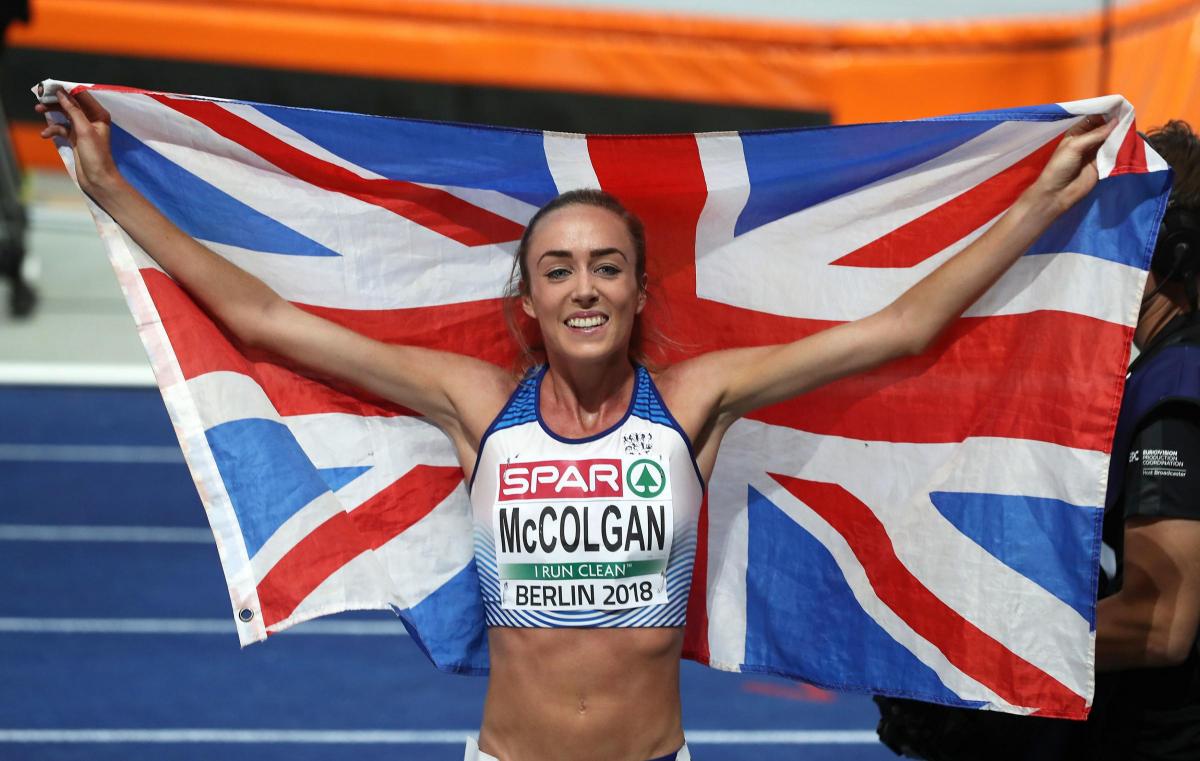
With the 2019 World Athletics Championships well underway, Julia Cook takes a look into the issues of body shaming that have become more and more prevalent in track and field over recent years.
There’s no doubt about it, Eilish McColgan is having a sensational year.
Recording personal bests across five distances since January and fresh off being crowned the British 5000m champion, she’s been going from strength to strength.
So strong is her form at the moment that some are tipping her as having an outside chance of claiming a maiden World Championship medal in Doha later this week.
However 2019 hasn’t all been plain sailing, with McColgan having faced sponsorship struggles, a robbery and body shaming.
Fortunately the former of those problems has already been solved, with ASICS snapping up the 28-year-old after a year of the Scot having no sponsor at all.
However it was this new partnership that led to her being body shamed, with comments such as “damn that’s skinny” and another adding, “yes… bit too much” appearing on an ASICS Instagram post that featured the 2018 European silver medallist.
You just have to look at her impressive performances on the track to see that her size plays no impact on her running.
She didn’t just win the national title a few weeks ago; she dominated the field, taking victory by almost 15 second and also lowering her own personal best in the process.
While she could have kept quiet and ignored the comments, McColgan chose on this occasion to fight back, highlighting the potential issues that body shaming can have on young girls and women and reminding them that ‘It’s YOUR fabulous body.’
Nothing pisses me off more than someone making a comment that I’m ‘too skinny’. I’m naturally small-always have been. Some people are just slim! 😠
I doubt they would comment on someone slightly larger than ‘average’. I’m a healthy athlete and human. Go body shame elsewhere!🙄 pic.twitter.com/TmQtghTemn
— Eilish McColgan (@EilishMccolgan) August 12, 2019
It’s no surprise that young girls feel the need to get boob jobs, big plastic arses and contour themselves down to their kneecaps to fit what’s deemed the ‘ideal’ body.
If you’re healthy and happy then don’t worry about anyone else’s opinion! It’s YOUR fabulous body. ❤
— Eilish McColgan (@EilishMccolgan) August 12, 2019
Sadly, this is not the first time that women within athletics have found themselves on the receiving end of this kind of abuse.
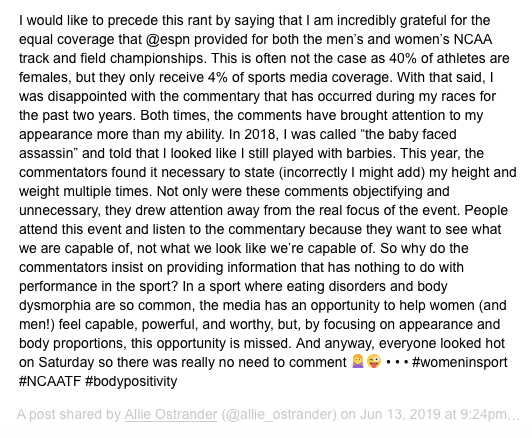
American Allie Ostrander – who just missed out on a place in the 3000m steeplechase final in Qatar – found herself at the centre of a body shaming debate back in June, calling out commentators for talking about her appearance, rather than her performance.
As she stormed to a third NCAAs title in the event, commentators focused not on her achievements but instead decided to recite statistics about her height and weight. Even worse, the numbers they shared turned out to be incorrect.
Taking to Instagram to explain her frustrations, Ostrander said: ‘Not only were these comments objectifying and unnecessary, they drew attention away from the real focus of the event.’
Like McColgan, she also highlighted the impact that commentators can have on the listeners, especially in a sport where eating disorders are rife, stating: ‘The media has an opportunity to help women (and men!) feel capable, powerful, and worthy but, by focusing on appearance and body proportions, this opportunity is missed.’
Whilst the focus on how their bodies look is particularly an issue for women, recent comments directed towards Olympic, World, European and Commonwealth champion Greg Rutherford show that men are not immune to body shaming either.
He also used social media to hit back at trolls who pointed out his ‘dad bod’ whilst he was training for a charity swim.
“I very much realise I’m not in the shape I was as a professional athlete. I’m fine with that, I love cake and beer…” he responded.
It’s not just McColgan, Ostrander and Rutherford who have sparked debate on body shaming within track and field either. Very few athletes seem to be immune to the comments, including some of the biggest names the sport has seen.
Just weeks before her stunning Olympic gold medal in London – seven years ago – Jessica Ennis-Hill was branded “fat” by a high ranking official, causing her coach Toni Minichiello to dismiss the criticism.
Another who has had to endure comments about her body is three-time Olympian Amber Campbell, a hammer thrower for whom many have chosen to focus solely on her size and shape instead of recognising her achievements on the field, including finishing sixth at Rio 2016.
Olympic and World bronze medallist Anyika Onuora also bravely opened up last year about body confidence issues and having to endure abuse about her physique growing up from some high ranking individuals in the sport. She is now using her experiences to inspire the next generation to love and accept their bodies.
Olympic medallist @annyonuora reveals being called fat and told to lose weight by ‘people up top’.
More on ‘Body image, BMI and Brazilian butt lifts’ from the #siscollective podcast:
🎧🍏https://t.co/SuWSP41lw1
🎧🤖https://t.co/P0S14qwd86
📖 https://t.co/kLrxKQdAHp pic.twitter.com/IUJktPV2od— BBC Radio 5 Live (@bbc5live) December 10, 2018
Track and field is an incredible sport where any body shape can excel. Every athlete may look different but there is one consistent; they’re all world class athletes at the top of their game, showing truly that it doesn’t matter what your body looks like, but rather what it is capable of.
By focusing on the size and the shape of athlete’s bodies, people are suggesting that not only do they need to be at the best in their sport, but also be compliant with societal standards of what they should look like at the same time.
The need some people have to body shame online has always been a confounding issue and by challenging it these athletes are bringing to attention the fact that it should never be the case in sport where we focus on what the body looks like.
Instead our attention should be solely on what these bodies can achieve.
If I have one message to the trollers, it’s this: The quality of your life has not decreased because you’re not telling the internet your opinions of an athlete’s body, and yet your silence greatly increases the quality of theirs.
The Dream Gap Tour: How 200 players are fighting to change the face of women’s ice hockey

Alasdair Hooper takes us through the almost unprecedented situation in North America where many of the world’s best ice hockey players are refusing to play professionally in order to get the rights they deserve.
Imagine a scenario where 200 of the best footballers refused to take part in an FA WSL season until they got the resources they deserved.
Consider the likes of Steph Houghton, Kim Little and Fran Kirby all sitting out; think about what a bombshell moment that would be.
The point behind bringing you this hypothetical case study is because that is exactly what has happened in women’s ice hockey.
It was one of the most dramatic moves in an eventful 18 months for the sport – but it’s a move that could transform things for generations to come.
Turn back the clock to February 2018 and the United States national team won Winter Olympic gold for the first time in 20 years.
In doing so they finally overcame arch rivals Canada, with recognisable stars such as Hilary Knight arguably becoming more popular than ever have been before.
But just over a year on from that triumph, women’s ice hockey was left stunned when the Canadian Women’s Hockey League folded in March 2019 after 12 seasons.
The reason behind its demise was supposedly an insufficient financial model and a funding gap.
That meant ice hockey stars like Knight, and Canadian forward Marie-Philip Poulin, were without a team for the upcoming season.
With the Canadian league gone the presumption was that stars would flock to the five-team National Women’s Hockey League (NWHL) in America – the only remaining and viable professional league for women.
But that didn’t happen.
Instead, 200 players announced in May that they wouldn’t be playing in a women’s professional league this season “until we get the resources that professional women’s hockey demands and deserves.”
Among the 200 was Knight, Poulin and also Kendall Coyne Schofield who, earlier in 2019, had become the first woman to compete in an NHL All-Stars skills competition.
Usually rivals, many 🇺🇸🇨🇦 top female hockey players opted not to play in a league this season to fight for a bigger, better professional league for women. We had a look at their #DreamGapTour in Toronto. #ForTheGame
📷 Marko Ditkun / HHOF Images pic.twitter.com/kNmCP9wsS4
— IIHF (@IIHFHockey) September 24, 2019
The Dream Gap Tour
Following the bombshell announcement, we witnessed the formation of the Professional Women’s Hockey Players Association (PWHPA).
This season the union launched The Dream Gap Tour, essentially a tour made up of PWHPA members looking to bring together the sport’s key stakeholders to the table to establish a single league with a sustainable economic model.
The tour’s first stop was last weekend (September 20-22) in Toronto with union members playing in exhibition games against Boston College on the Saturday and against alumni of the San Jose Sharks on the Sunday.
“We as players are playing with the intention of leaving this game better than we entered it,” Coyne Schofield told Reuters.
“And we have control over our image, our skill, our talent and ultimately the product we put on the ice.”
There is no doubt that the PWHPA and The Dream Gap Tour should be taken seriously.
Not only does it have a host of stars behind it, it also currently has tennis and equality pioneer Billie Jean King’s company serving in a leadership and guidance role.
On Friday September 20, the National Hockey League Players’ Association (NHLPA) also announced it would serve as a PWHPA sponsor.
“The main goal has always been the main goal: that’s to build a sustainable, viable option and we haven’t seen that quite yet,” said Knight to Reuters.
“There’s a reason why there’s collective minds that are out there trying to forge a new future for the game.”
THANK YOU @SanJoseSharks and @SharksAlumni for an incredible weekend in San Jose. You sought out the mission of the @PWHPA and provided us with this opportunity to make a lasting impact on the game together. Thank you. 🦈 #TealTogether #ForTheGame pic.twitter.com/ymN0vpid69
— Kendall Coyne Schofield (@KendallCoyne) September 23, 2019
“It was the kick in the butt we needed”
The tide is turning in women’s sport. The birth of the PWHPA is just a small example of that.
Female athletes aren’t just content to play their sport anymore – they’re in it to fight for the pay and conditions that they feel they deserve.
They’ve been neglected these rights for far too long.
“It was obviously devastating when the CWHL folded,” Sarah Nurse – who played for the Toronto Furies last season – told ESPN.
“But it was the kick in the butt we needed to push for what we truly want and what we truly deserve.
“It was very easy for a lot of the girls to be happy in the spots that we were in and not push for more. We didn’t want to take a lateral step, we wanted a step forward.”
She added: “It’s not just the pay equity and pay gap – that will come, and we know that’s something that is not going to come overnight.
“But it’s the professionalism that we’re looking for. Simple things like getting our laundry done, ice time before 9:30pm at night, being able to travel on the road with a full staff.
“Last season we often travelled without our athletic therapist and medical team, we were often sharing medical staff with other teams.
“Our coaching staff didn’t have access to video resources, they didn’t have their own locker rooms. Our equipment manager couldn’t give us laces or hockey tape. We had to go buy them ourselves.”
Alyssa Gagliardi, who played for the Boston Pride in the NWHL last year, also told ESPN: “We didn’t want to just jump into the only option, because it was the only option.
“We wanted to make sure we were thinking long term about the future of the sport.
“I was grateful to have the NWHL opportunity but, looking forward, I want to be part of a professional league where I can make a liveable wage, have health insurance, full-time staff, all of those aspects.”
This logo gives me all the feels! ❤️ 5 year old me is jumping up and down knowing that there are so many amazing people fighting so that the #DreamGap is CLOSED for women’s hockey in the near future! pic.twitter.com/4sW4DdqsoB
— Alexis Miller (@alexis_millller) August 28, 2019
“We’re not going anywhere”
So, what of the NWHL? Its league season starts on October 5 but Dani Rylan – the NWHL commissioner – is defiant.
“We’re not going anywhere,” she told ESPN.
“It’s definitely disappointing, to say the least, when the people that you built a business for, or a platform for, feel that destroying that business is the best way forward.”
You get the impression that – not only do the PWHPA see the NWHL as insufficient – they also see it as a major hurdle.
Long term the goal here for many of the boycotting players is to create a single women’s pro league that has the support of the National Hockey League (NHL), much like the way the NBA supports the WNBA.
During her interview with ESPN earlier in September, Rylan admitted to taking the move personally.
“Yes, I do. And I think there are some players where it hurts a little bit more that they made this decision,” she said.
“Not just hurts me personally, but also the other people in the league who invested in them, who have done a lot to help players grow their brands and grow as hockey players.
“Maybe that means players that made the national team who weren’t in that conversation before,” she said.
For the next generation 💪🏼 pic.twitter.com/uL6p8Cr7P6
— PWHPA (@PWHPA) September 23, 2019
Is it worth the risk?
All of this means there are several questions, which we don’t know the answers to.
For example, is there a rift between PWHPA players and those in the NWHL? Not publicly at this stage anyway.
“Everyone’s situation is different,” said Gagliardi to ESPN.
“I have friends who are playing in the NWHL – they’re still good friends. We respect everyone’s decision.
“Ultimately I saw this as an opportunity to be a voice for change for the future. We’ve all had to have an internal conversation with ourselves. And if my hockey career is done, and I never get to play a professional hockey game again, I’m OK with it – knowing the next generation might be able to do it for a living.”
That is ultimately what is at stake here. The risk versus the reward.
It’s undoubtedly a risk to go it alone without the NWHL. It’s a risk going down the line of wanting to create a league with the backing of the NHL. And it’s a major risk in potentially sacrificing your professional hockey careers for the next generation.
But what it has done is woken everyone up to the harshness of the situation. These conditions can’t go on and it takes a bombshell moment like this to force that change.
This is a risk worth taking.
Record FA WSL Attendances A Start; Now Let’s Make It Regular
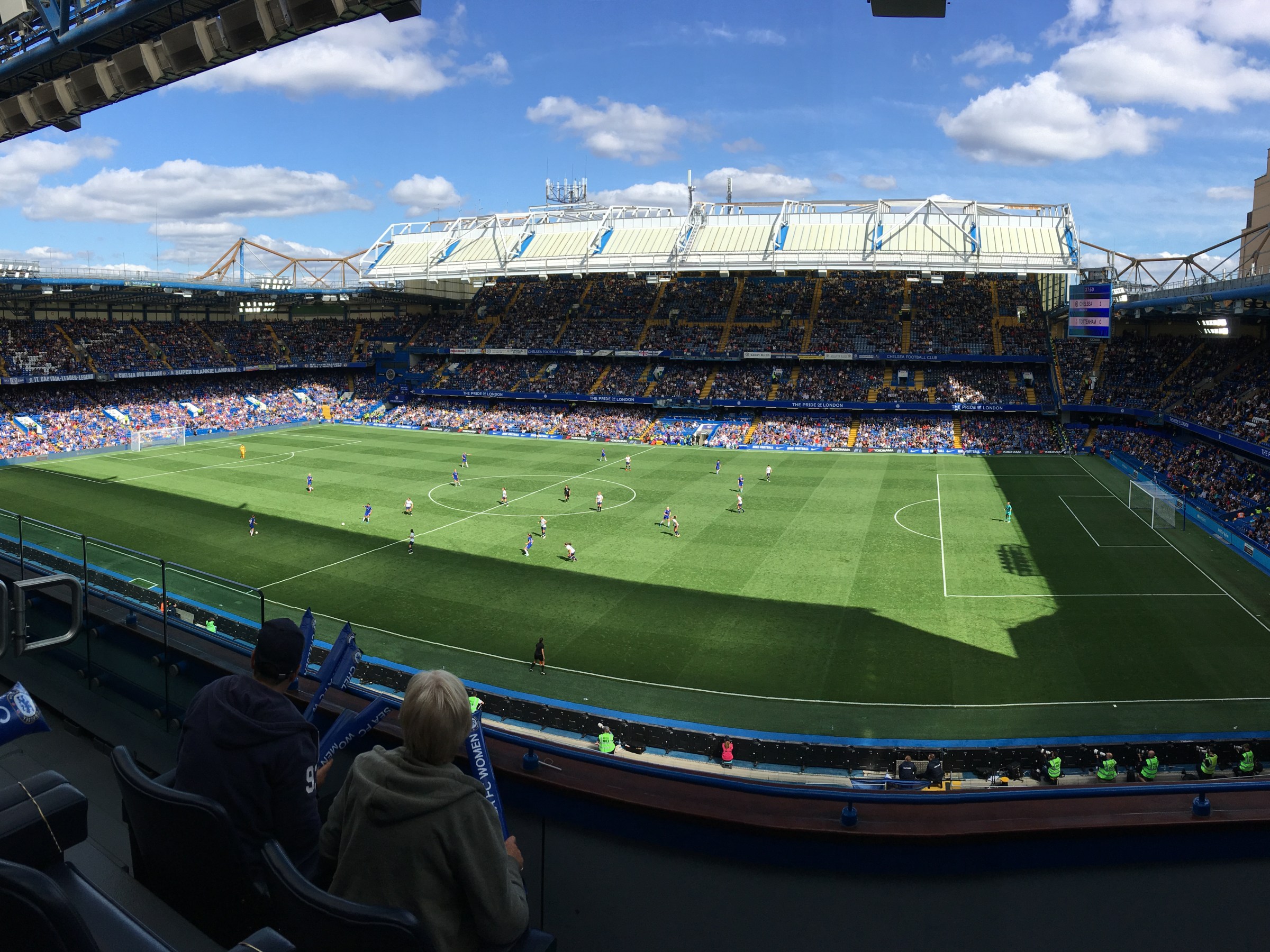
With record attendances at the opening weekend of the 2019/20 Barclays FA WSL season, Reading’s Remi Allen tells us why the players want nothing more than to play in front of packed stadiums every single week.
The FA WSL made its long awaited return earlier this month, an exciting time for everyone involved in women’s football after all the backing and support shown to the game during the 2019 FIFA Women’s World Cup.
Two exciting opening derby fixtures – Manchester City v Manchester United and Chelsea v Tottenham – were the pick of the bunch, not only due to the nature of the rivalries but also they were being held at the Etihad Stadium and Stamford Bridge respectively, with record crowds expected.
Chelsea created a great atmosphere, bringing in more than 25,000 people, while Manchester City attracted the biggest ever FA WSL crowd of 31,323 – that’s around six times more fans than the previous best.
Over 31,000 of you here at the Etihad today.
A record attendance for a @BarclaysFAWSL game. Thank you! 💙 pic.twitter.com/2Lz58uuyeQ
— Man City Women (@ManCityWomen) September 7, 2019
Surely this shows great progress in the women’s game right?
My answer to that question is inherently yes; however we cannot allow that to become a one off or something that just happens only when we play in the biggest mens stadiums.
Bristol City also hosted their first game in a stadium usually frequented by the men, a clever move that saw them playing in front of 3,041 fans at Ashton Gate.
But the other games only drew in crowds of around 1,000 people. While still above last season’s average attendance of 833, there is obviously a huge difference in numbers there.
As a professional footballer, I am not naive enough to believe we have the capabilities to attract crowds of 30,000 week-in week-out just yet but I do believe we can keep striving and pushing for better.
The women’s game is far more accessible than it has ever been in terms of social media, TV coverage and the ability to connect with players. The fact that we now have the ability to watch every game on The FA Player is also a huge step in the right direction.
I would encourage anyone not sure on women’s football to watch via this, just to be able to appreciate the sheer quality of our game, how hard we work and actually how enjoyable it is. I think the more people that buy into this the more likely it is to get them to physically attend matches.
Women’s Football Weekend announced for the weekend of our @BarclaysFAWSL match against Bristol City at the Madejski Stadium. 🥳
Read the full story ⬇️
🔵⚪️🔵⚪️
— Reading FC Women (@ReadingFCWomen) September 18, 2019
And actually attending women’s football matches is quite frankly a bargain in terms of pricing while also an unbelievable way for all young boys and girls out there to watch their role models live. It’s a great opportunity for them to see how you can have a dream and it can become a reality.
We were once them kids dreaming of a game we loved and now we get to live it every single day. It is literally our dream job.
As for me, I think it’s brilliant to play in some of the best stadiums in the world but what I find even more incredible is playing in front of a huge crowd, experiencing the buzz of them singing your name, the pure joy it brings to their faces and the interaction we as players get to have with them afterwards.
In total 63,000 fans travelled the country to watch the opening games of the FA WSL. It was an amazing start to what is going to be one of the most exciting seasons to date.
So let’s not take our foot of the gas. Keep coming, keep supporting in big stadiums or small stadiums; it doesn’t matter.
We need you.
#BeSeenBeHeardBeInspired – The Next Chapter For The 52
Women’s sport is receiving more coverage than ever before
But gender equal media sports coverage can’t be a fad; it needs to be the norm
We are dedicated to giving women’s sport the platform it deserves
The platform to #BeSeenBeHeardBeInspired
🔗 https://t.co/kwcMbxk70v pic.twitter.com/2v21WQniOx
— The 52 Blog (@the_52blog) September 14, 2019
What a summer it’s been for women’s sport.
There were World Cups and Ashes series. Joy and despair. Elation and ovations. Heartbreak and heartache.
Medals were won, goals scored, wickets taken.
The skill levels never wavered from world class, with barely believable sporting brilliance happening at regular intervals.
Not that this was different to any normal summer.
No, the big change wasn’t on the field – it was off it. For once, all of the action took place in full view of the public eye.
The action wasn’t unprecedented but the level of media coverage certainly was.
A recent study by the Women’s Sport Trust revealed between 7 June-14 July, around 46% of the top ten stories and 54.5% of the ‘most watched video clips’ on the BBC Sport website featured women’s sport.
Furthermore roughly a third of the leading sport stories on the Telegraph’s (30.2%) and Guardian’s (28.3%) online sport pages during the Women’s Football World Cup and Wimbledon were about women’s sport.
Over the summer we looked in detail at the volume and prominence around women’s sport coverage on leading websites in the UK.
Did media outlets really #ChangeTheGame for women’s sport? Check out our findings here: https://t.co/TwfN7cZt8a pic.twitter.com/lD3KrLq6Od
— Women’s Sport Trust (@WomenSportTrust) September 4, 2019
And then there was the TV and radio coverage. BBC showed every single Women’s Football World Cup match, a decent proportion of which on its main channels, while Sky Sports also showed every game from the Netball World Cup and the Ashes.
The Beeb also aired many of the netball games, while talkSPORT played radio host to the football World Cup.
The Telegraph and GiveMeSport also launched dedicated women’s sport sections, while the BBC ran their #ChangeTheGame campaign.
Never before had we been exposed to this level of coverage dedicated solely to our female athletes. Perhaps for the first time, we as fans could fully immerse ourselves in women’s sport over a concert period of time.
We cheered. We cried. We punched the air. We screamed at the TV. We emulated celebrations. We debated.
And all because we were given the chance to.
Despite what the minority may argue, women’s sport wasn’t shoved down our throats. It wasn’t portrayed so heavily in the media just to tick a box. It didn’t dominate the back pages just to pacify the PC brigade.
It was shown simply because the demand is there.
We proved this last year with more than 6,000 hits to our site despite being a tiny independent blog with no financial backing whatsoever.
If we can achieve that, just think of the reach women’s sport could get if ALL the major outlets took it seriously.
Introducing Telegraph Women’s Sport: A new era of unprecedented coverage https://t.co/pFoJryZoBr pic.twitter.com/aiTKgwzloS
— Telegraph Women’s Sport (@WomensSport) March 18, 2019
That is where we face our biggest challenge yet.
Gender equality in media sports coverage can’t be just as a fad; it needs to become the norm.
The results from this summer are hugely promising but they can’t be a one off. We can’t go back to a time where less than 3% of sports photos in national newspapers are of women, with days where absolutely no women were depicted whatsoever, as found by Totally Runable as recently as 2018.
As a result, as part of our rebrand, The 52 is dedicating itself to ensuring exactly that happens.
By recruiting an expanded writing team to cover as many areas of women’s sport as possible to give the deepest insight, we are aiming to give women’s sport the platform it deserves.
The platform to #BeSeenBeHeardBeInspired.
#BeSeen
Women’s sport cannot flourish any further if it’s not given a chance to. This summer has proved the demand for it is there amongst the British public and now we need to make sure the level of coverage only continues to grow.
We need to treat women the same way in which we treat the men though. That’s not only profiling the incredible stories and recognising stunning achievements but also tackling the more important issues too. If a point needs making, we will make it. If a controversial topic needs addressing, we will address it. If a question needs asking, we will ask it.
#BeHeard
The more we see women’s sport, the more likely we are to talk about it. How cool would it be to overhear children discussing whether they’d rather be like KJT or Dina Asher-Smith? People at the pub debating whether Leanne Riley or Natasha ‘Mo’ Hunt should start at scrum half for England in their next Six Nations game? Groups of friends gathered round a phone trying to work out whether they can attend the next round of Barclays FAWSL fixtures?
While it’s crucial to make gender equality in sports media the norm, this will only allow us to reach a certain number of people. We need to get people talking about women’s sport with their friends, uncles, neighbours and strangers in the street if we are going to make sure it reaches everyone in the country.
#BeInspired
For too long aspiring female athletes grew up with only male role models to copy. Many of those who have made it to the elite level have often said they were barely aware of their female counterparts.
But we are now in a position to change that, to inspire girls to want to take up a sport and try to emulate their female heroes, if we make sure women’s sport continues to be seen and heard.
Of course there’s nothing wrong with a young female cricketer wanting to be the next Ben Stokes. But at the same time she should have the option to aspire to emulate Katherine Brunt or Georgia Elwiss too.
If we want to inspire the next generation, we need to increase how much we see and hear about women’s sport. And the more the next generation are inspired, the more we will see and hear about women’s sport.
That’s what we want. True media equality, giving women as much coverage as men, good or bad.
The chance to #BeSeenBeHeardBeInspired.
WRITING OPPORTUNITY: Join The 52
Women’s sport is in the best position it’s ever been.
More people are watching, playing, reading, writing and talking about it than any other time in recent memory.
Three major outlets – BBC, The Telegraph and GiveMeSport – now all have dedicated campaigns to supply the content demanded by so many and the level of coverage across most media outlets seems to be on the up as well.
At The 52, we like to think we have played a small part too – we received nearly 6,300 hits on our website during our year-long project to champion and promote inspiring individuals, teams, groups and schemes in women’s sport.
There is still a lot to be done though.
Outside of major competitions, there is still a large disparity in terms of the coverage afforded to women’s sport.
Quite rightly, the demise of Bury and Bolton has been dominating the headlines in the last few weeks. The outrage has been clear and there have been seemingly endless debates on what can be done to stop this happening again.
But where was the coverage when a similar fate happened to Notts County’s women’s team back in 2017, when England internationals found themselves out of a job overnight? Or just last season when Yeovil’s women were forced to revert back to part-time status while still in the top-tier Women’s Super League?
How many of you read anything about the inaugural W Series as it happened this year? Golf’s Solheim Cup – the women’s version of the Ryder Cup – begins in Scotland in just two weeks; how much have you heard about that? What about the fantastic success of GB’s female para-canoeists at the recent World Championships?
There is still a lot of work to be done and The 52 wants to be at the heart of that, giving women’s sport the platform it deserves.
However, if we are going to make a significant difference then we need YOUR help!
As part of our exciting re-brand over the next few weeks, we want to put together a team of writers with a range of knowledge and expertise to give the best possible insight into women’s sport; to elicit debate and discuss the most important topics; to bring you the stories that may have gone untold by the major outlets and continue to promote the incredible people within it.
You can write as much or as little as you like; it can be once a week, once every two months or even just a one-off article.
You can write on pretty much any sport you want, from the mainstream events such as football, rugby and cricket to boccia, archery and cross-country skiing. The choice is yours!
So far we have already been fortunate enough to recruit an Olympic champion hockey player, a world champion trampolinist and two exciting young journalists and really hope to add even more talent to that roster.
So if you’re an athlete, coach, aspiring (or current) journalist or someone who is heavily involved in women’s sport, we want to hear from you!
All you need to do is send us an email to editor@the52blog.co.uk or a message on Facebook, Twitter or Instagram (you can find us @the_52blog).
We can’t wait to hear from you!
 The 52 Blog